

I wrote how the current political campaign “seethes with the anger and frustration of voters who seem to be sick of whatever they consider to be the corrupt, broken ‘establishment.’”
No, not this summer. But the sentiment still feels relevant as we lurch toward a bitter 2026 midterm election with $11.6 billion in political ads flooding into every digital nook and cranny.
Those words were published a decade ago as the first line of my front-page column in the Des Moines Register on Monday, Feb. 1, 2016. I provided a snapshot of that year’s presidential campaign on the day of the Iowa caucuses, more or less the official starting line of the national race.

I doubt you think that anger and frustration has ebbed in the least. And more of it now seems aimed at the two major parties.
Today there are more political independents than Gallup has ever measured — a new high of 45%, with Democrats and Republicans tied at 27% each. That includes 56% of Gen Z adults, a higher rate than millennials or Gen X claimed at similar ages.
Call this emerging era whatever you prefer. Post-Trump, post-COVID, post-AI, post-shame, post-irony, post-whatever. Ultimately, America still seethes. What had been a two-party system wrangling with recurring factions now feels more like a fractured electorate ducking major-party labels entirely.
Iowa remains an overall “red” state with 711,587 active registered Republican voters according to the most recent tally from the Iowa secretary of state. Independents (555,309) outnumber Democrats (527,675), a flip that only happened after 2024. But both parties this year have made registration gains, with primaries and the stakes of the midterms to galvanize voters’ attention.
Another thing has changed since 2016, at least for now: the Iowa caucuses have been booted from the front of the presidential nomination calendar by the Democratic National Committee.
My 2016 column was pegged to the caucuses and built on my own reporting around the state, including one memorable evening in Mason City. An event in late January featured Susan Sarandon lending star power to Sen. Bernie Sanders of Vermont to rally more than 1,000 Iowans at Music Man Square. Just blocks away, former President Bill Clinton spoke to a crowd of a few hundred at the local high school on behalf of his wife, former Secretary of State Hillary Clinton.
I wrote that Sanders “embraces what had been assumed to be the politically lethal adjective ‘socialist’ and proclaims a Woodstock-era distrust of Wall Street.”
I spoke to a local farmer at the Sanders rally who said he was still deciding between the progressive populist and Donald Trump in his admiration for a candidate who was “for the small person” and “a new middle class.”
It took me a beat to regain my composure before I continued scribbling in my reporter’s notebook.
My conversation with that Iowa farmer — seemingly willing to equally entertain iconoclasts from the right or left in the name of disrupting the system — was my personal wakeup call to the rising partisan identity crisis rippling through the electorate. We’ve since seen the MAGA takeover of the GOP and, more recently, the rise of the Democratic Socialists of America on the left flank of Democrats. Political factions are as old as humanity. But we also live in a hyperconnected world where it’s easier for lone influencers and crypto bros to rally support and raise money outside party channels.
Sanders himself typifies fluid modern partisan identity: Even though he caucuses with Democrats, he’s the longest-serving independent in congressional history. And despite identifying as a democratic socialist, he’s not a member of the DSA — unlike rising star Zohran Mamdani, New York City mayor, or Francesca Hong, the Wisconsin state lawmaker who narrowly lost this month’s Democratic primary for governor. Yet Sanders did help ignite a membership boom. By the group’s own count, DSA has climbed from roughly 6,500 before his presidential bid to more than 120,000 this summer.
Party names conspicuously absent from ads
We need to be careful not to carry this “party’s over” theme too far, even as favorability for both parties hovers around historic lows. We know from plenty of consistent research that most independents reliably lean right or left — in other words, they tend to reject the label more than the candidates or the policies. Yet overt party affiliation under the traditional “D” or “R” still feels passe. Just look at what the campaigns themselves have concluded.
Our gubernatorial race includes Democrat Rob Sand, who criticizes the two parties as “private clubs” and touts Republican supporters (“Rob-Publicans”) in his campaign ads. His opponent, Republican Zach Lahn, prefers a MAHA tone to MAGA — and won the GOP nomination despite President Trump’s endorsement of U.S. Rep. Randy Feenstra. Lahn also spends enough time talking about water quality, Iowa cancer rates, and “Big Ag” nitrates to overlap environmental talking points with Sand or Chris Jones, the Democratic challenger running for Iowa agriculture secretary.
Iowa state Rep. Josh Turek, running for the open Senate seat against U.S. Rep. Ashley Hinson, is among a batch of Democratic Senate candidates nationwide running ads taking on their own party and highlighting bipartisan work. His own ad proclaims the “more than 700 times” he voted with Republicans in the Iowa House.
I struggle to spot the name of a party in any Iowa campaign ads currently streaming — unless we’re talking about Sand’s Rob-publicans.
This down-the-middle strategy may be registering in the polling. A recent Emerson College Polling/Nexstar Media survey shows Sand winning independents by 26 points and Turek by 11. (Yes, midterms almost always punish the president’s party.)
Meanwhile, the nonpartisan Cook Political Report spurred headlines by moving both these Iowa races a notch to the left, the governor’s race to “lean Democrat” and the open Senate seat to a “toss-up.”
Next door in Nebraska, Dan Osborn is one of a handful of independents nationwide running for Senate with Democratic backing. He says he won’t caucus with either party if he wins.
Life in the ‘politically messy center’
The rise of independents is a reminder that political identity, for most of us, is never really as simple as left or right.
Pew Research Center observed this summer that “beneath that familiar red-blue partisan divide is a much more nuanced picture: Many Americans hold a complex mix of values and beliefs that don’t always fit neatly into either major party.” Pew’s typology, built on political and cultural values rather than party identity, sorts the electorate into nine groups:
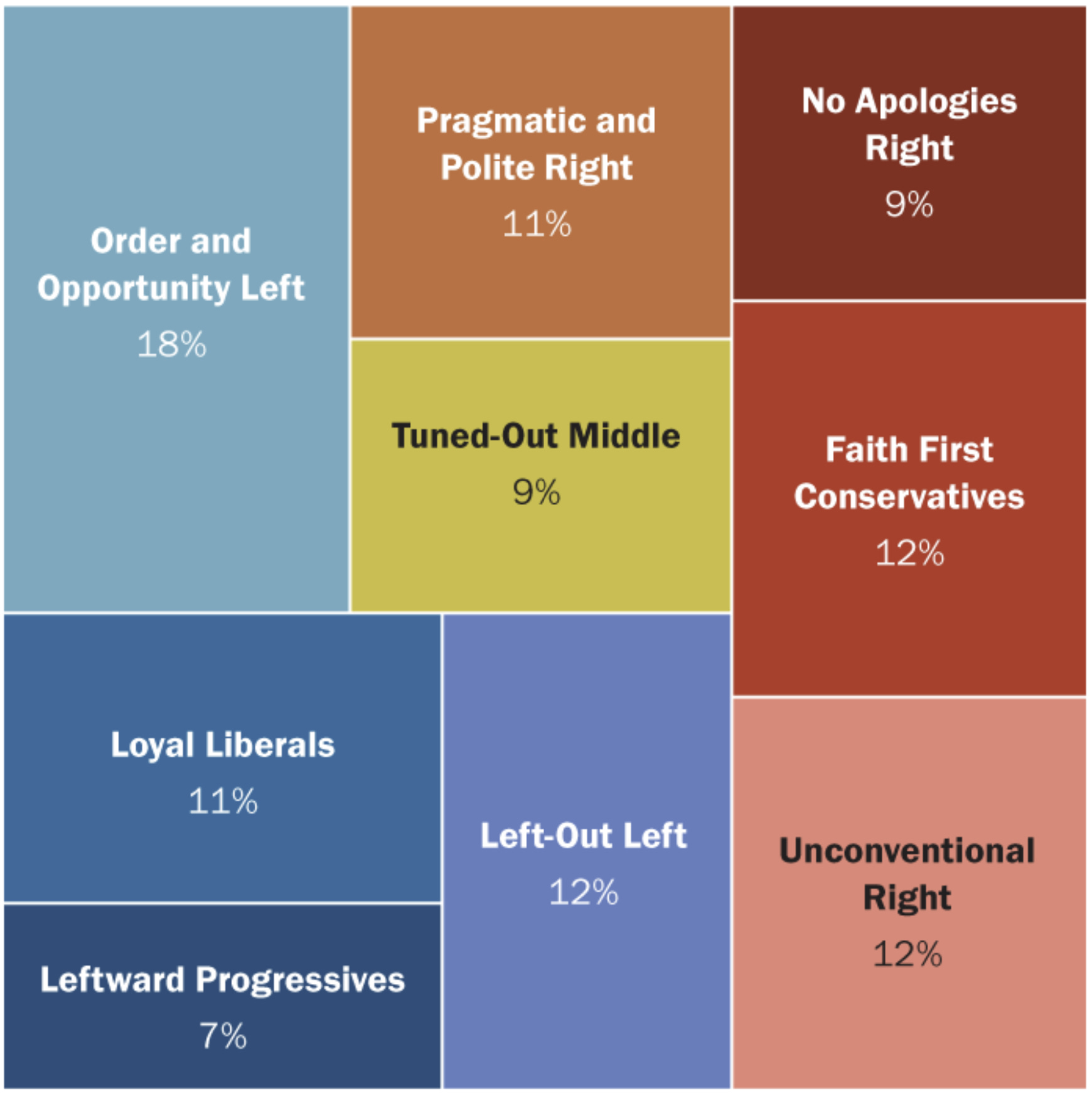
Most of us land in what Pew calls a “politically messy center” — even those of us who clearly favor one party over the other.
That means most of us are neither consistently liberal nor consistently conservative. And about 15% of Republicans and Republican leaners hold values that place them left of center overall, with a similar share of Democrats landing right of center.
Believe me: I realize the “Tuned-Out Middle” and eight other groups of this typology add up to a nuanced academic exercise that won’t find its way into the $11.6 billion in midterm (mostly attack) ads. I expect to hear more weaponized use of “socialist,” “communist,” “fascist,” and whatever else consultants dream up.
So I’ll keep thinking about the farmer in Mason City instead, who had no trouble holding two opposite candidates in his head at the same time. I filed him away as a curious bellwether worth one paragraph and never called him back.
The parties have spent the past decade trying to catch up to him.
Iowa Writers’ Collaborative
I’m proud to be a member of the Iowa Writers’ Collaborative. Meet our writers here, or subscribe to our free weekly roundup and our Wednesday “Flipside” edition featuring sports, music, culture, and other topics.