

Y’all reading this probably qualify as grammar nerds just by spending time here on Substack rather than, say, swiping through endless TikTok videos.
And if you stopped and pondered my use of “y’all” to open the last sentence, you’re definitely a grammar nerd. I can imagine your inner dialogue:
I don’t think he’s used “y’all” before — why now?
He’s no Southerner — is he appropriating a regional voice, or mocking it?
I’m trying to make a point: few things are as universal as grammar when you really stop to think about it. As a species, we’re driven to communicate, and we’ve developed written language to do so across time and distance. In today’s digital world, grammar is splattered everywhere on our screens, instantaneously, across every platform. Text messages and IMs are sprayed with random capitalization and punctuation. Some of today’s social media gibberish makes U.S. Sen. Chuck Grassley’s idiosyncratic Twitter abbreviations of the 2010s look eloquent. Auto captions on videos regularly mangle words.
One couple is doing more than their fair share to clean up our modern grammar mess by clarifying the rules — and doling out a little therapy in the process.
Lifelong writer, teacher, and linguist Ellen Jovin began her grammar crusade on Sept. 21, 2018, near her apartment in New York. She set up a small folding table piled with reference books, hung a sign that said “Grammar Table,” and offered to answer questions from any passersby. Her husband, Brandt Johnson, began filming the encounters.
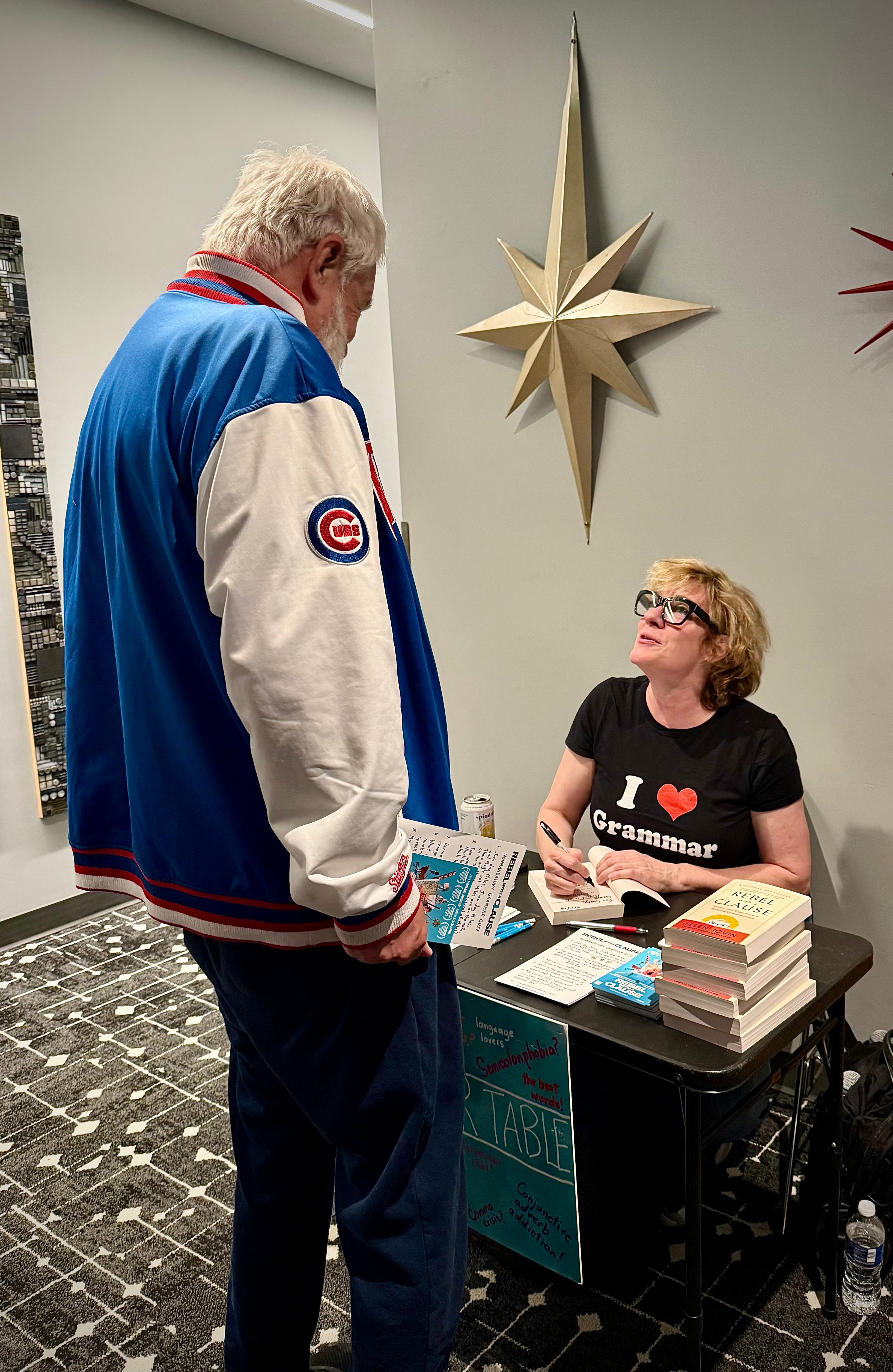
Fifty states and nearly eight years later, Jovin sat behind her very same Grammar Table in the lobby of Varsity Cinema in Des Moines to answer yet more questions — this time just before a capital-city premiere screening of the couple’s documentary, “Rebel With a Clause.” Jovin also wrote a book by the same name, “an unconventional guide to the English language, drawn from the cross-country adventures of an itinerant grammarian.”

“Y’all” figures prominently in the film thanks to a gregarious pair of young construction workers on the streets of Decatur, Georgia, loudly debating the use of an apostrophe in the “you all” contraction.
“But a lot of people do put the apostrophe after the a, right?” Jovin says, sympathizing with one of the young men, Jason.
“They do, and I cannot stand it,” he says.
“Does this give me any Southern cred?” Jovin asks him.
“I think it does,” Jason says. “I have to say it does.”
It’s probably no surprise that the theater felt a little like a library before the show started, with many in their seats quietly reading books after visiting Jovin’s table. I went up too, but didn’t really ask her a question; instead I commiserated about how I’m annoyed at putting spaces around my em dashes to stay consistent with the AP Style I’ve followed throughout my journalism and writing life. Jovin admitted she was happier with the thin spaces her publisher used to buffer the em dashes in her book.
If you’re still reading after that last paragraph, you’re a hardcore grammar junkie, not merely a nerd.
Watching “Rebel With a Clause” with a live audience wasn’t what I expected: Gone was the library hush, replaced by uproarious comedy and regular outbursts of laughter.
On one hand, the film — and Jovin’s entire project — is steeped in technical rules. When and why should we use an Oxford comma in a list of items so the sentence remains fluid, precise, and clear? Are you confident about when to use lay vs. lie?
But on the other hand, the film is ultimately about how we relate to each other through grammar and what our words and punctuation say about the sort of better world we hope to build. In some ways I was reminded of last year’s “Pieowa” premiere at the Varsity — another film where a universal table topic triggered deeper humanitarian themes.
At one point in the film, Jovin recommends punctuation that’s “more musically appropriate.” That was music to my ears, because I think too few writers and readers pay respect to the sheer musicality of language. Prose deserves that musicality as much as poetry does. As Miles Davis and other musicians have observed in various ways, the silence or space between the notes (or words) matters as much as the notes (or words) themselves.
So when we talk about grammar, we’re really talking about the context of being human — and how we set up our relationships with each other for success rather than failure. Sometimes, everything can hinge on a single comma.
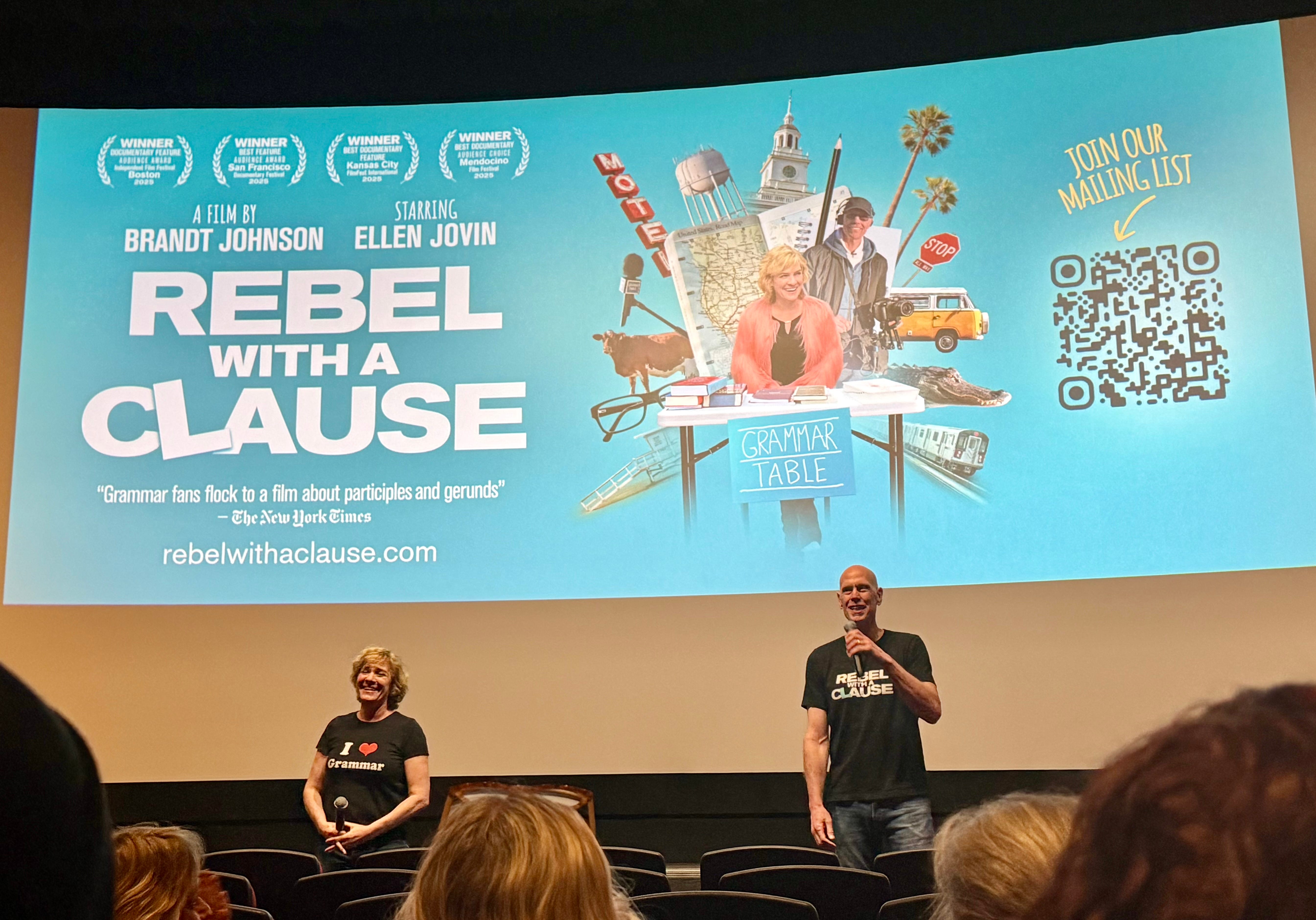
The Q&A after the film ranged widely. I learned that “champing” at the bit is the correct term for the idiom based on horses, but “chomping” has become so standard it’s probably what you hear and use anyway.
Inspired by a scene from the film, there was plenty more laughter over the two pronunciations of pasties: “pass-tees” as in the savory sandwich, and “pace-tees,” as in the nipple covers.
But somebody also asked the couple what they really took away from their ongoing project.
“What I came away with is people are funny and smart all over the place,” Jovin said.
That’s something worth remembering for y’all in today’s world. And maybe it’s no surprise that grammar, of all things, is the subject to unlock these deeper connections.
Iowa Writers’ Collaborative
I’m proud to be a member of the Iowa Writers’ Collaborative. Meet our writers here, or subscribe to our free weekly roundup and our Wednesday “Flipside” edition featuring sports, music, culture, and other topics.
Fun. Reminds me of Eats, Shoots & Leaves by Lynne Truss.
Calls to mind Bryson’s “Dictionary of Troublesome Words”.
And, again, “. . .hens and broads “lay”; everything else “lies”—Sara Engle, younger daughter of Paul, Iowa City, 1963.